Five decades creating high-impact innovative solutions for the country
Our mission
is clear
We are a public-private organization
whose purpose is to drive Chile’s transformation
towards sustainable development.
What we do
We have contributed to addressing the country’s challenges in line with each era. We identify strategic challenges and opportunities for Chile, coordinate public and private capacities, and design and implement solutions that generate impact.
The future is in our nature
“The future is in our nature” reflects a conviction about Chile and about the role that FCh has played over its 50 years.
On the one hand, it recognizes that Chile has exceptional attributes to face the challenges of the future: strategic natural resources, enormous potential in renewable energy, territorial richness, and biodiversity that today are gaining increasingly relevant value in the global economy.
But the future is also in our nature in a deeper sense. It lies in our ability to anticipate change, innovate, and build the capacities that each era requires in order to develop. That has been the essence of Fundación Chile since its origins: identifying opportunities before they are evident to everyone, connecting actors, driving new industries, and preparing the country for the challenges ahead. Because we believe that the future is not waited for or predicted; it is built. And building it has been, precisely, part of our nature over the past 50 years.
The story of our journey
The institution’s history has been expressed through different bets, successes, and failures, which together have consolidated a model that, in itself, represents an innovation.
Shortly before creating Fundación Chile in 1976, the institution’s founder, Raúl Sáez, made a clear diagnosis: Chile lacked an organization responsible for using knowledge to innovate. Therefore, his main objective in establishing the Foundation was to help balance our science and technology system.
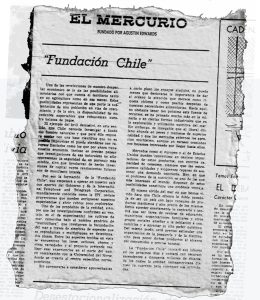
In August 1976, an editorial in El Mercurio highlighted the food production potential of Chilean territory and noted that the creation of Fundación Chile would make it possible to “open up little-explored sectors,” including the then-emerging field of mariculture. That vision would become foundational.
One of the main focuses was food innovation, with initiatives such as “El Galletón” (1976), which arose from the need to improve the quality of food provided to students in low-income schools; the promotion of family gardens in the urban area of Santiago (1977); and the Technical Assistance Center for the Food Industry (1977). In this regard, the most successful initiative was the production of shellfish seeds (1977), since one year later the first Pacific oyster farms prospered, with results that led to the production of 150 million seeds per year, including triploid seeds intended for export.
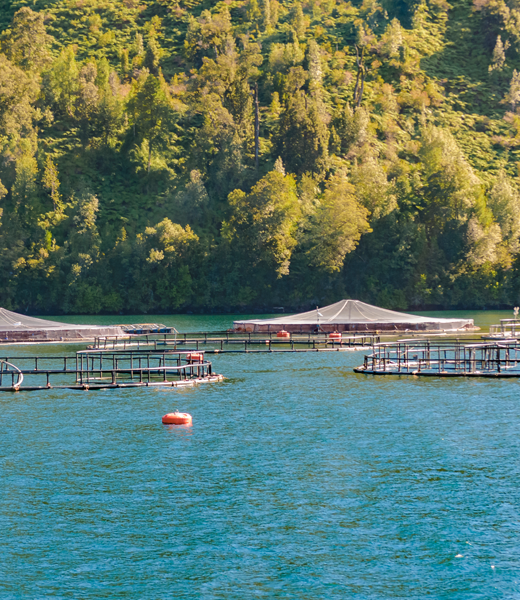
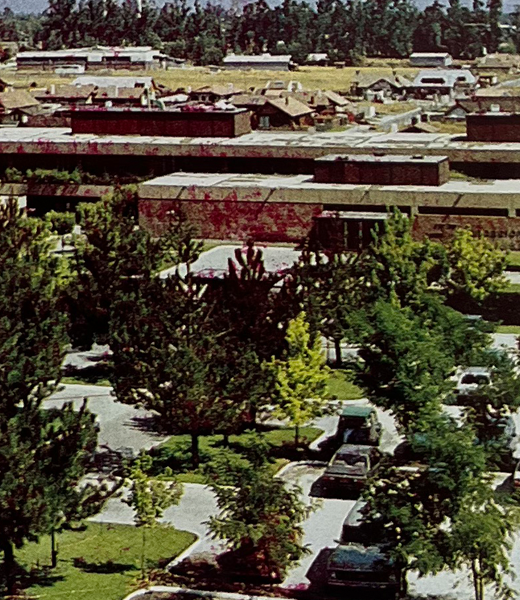
That is why Fundación Chile decided to bet on the sea, anticipating the country’s enormous productive potential. From its centers in Quillaipe and Tongoy, it developed experimental fish and mollusk farming, introduced new species, and created technical capacities that did not exist in Chile. It was not only about research, but about demonstrating that it was possible to modernize an entire industry.
The impact was decisive: the Foundation created 19 production companies in the aquaculture sector, as well as service, R&D, and input companies that enabled the growth of the entire value chain. Today, salmon is Chile’s second-largest export, the result of an early commitment to applied science, risk-taking, and long-term vision.
Fundación Chile created 19 production companies in the aquaculture sector, as well as service, R&D, and input companies that enabled the growth of the entire value chain.
In the early 1980s, the forestry industry ranked second among the country’s exports. However, despite its great potential, collaboration among companies in the sector on innovation projects was practically nonexistent. To help overcome this deficiency, toward the end of 1981 the Foundation created a forestry area. Together with four of the sector’s leading companies, a technological innovation program was created in the area of production, with Fundación Chile coordinating the initiative and taking on the role of technical secretariat.
The new program focused on improving productivity throughout the entire production process: from the construction of forestry roads, harvesting techniques, and wood transportation, to human resource management. It also included the promotion of new uses for wood in value-added products.
Through this project, Fundación Chile had one of its first experiences coordinating companies within the same productive sector. This model would become central to many of the projects developed by the Foundation from the late 1990s onward, which is where its importance lies.
While during its first years (1976 to 1981) Fundación Chile developed projects of social interest and provided technological services to existing companies, starting in 1982 it began using an innovative mechanism for technology transfer and dissemination: the creation of demonstration companies.
Through the creation of this type of company, the Foundation repeatedly showed that, when an opportunity existed and entrepreneurial capacity was available, in most cases it was possible to obtain the required technology, either within or outside the country.
This was fundamental in laying the foundations for the institution’s next ten years.
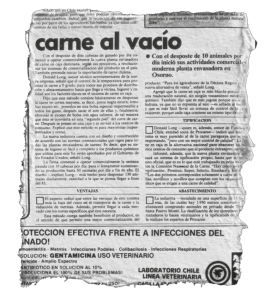
In 1984, Revista del Campo announced an unprecedented innovation: vacuum-packed meat. Fundación Chile promoted this change through Procarne S.A., a demonstration company created in Osorno in 1983, aimed at incorporating new technologies into the slaughtering, transportation, and commercialization of beef.
The system — explained by technical advisor Donald Long — made it possible to better preserve the product, improve hygiene, and transform distribution systems. The initiative was quickly accepted by supermarkets and wholesale markets, and its success was replicated by other actors.
Today, a growing percentage of the beef consumed in Chile is marketed using boxed, vacuum-packed meat technology.
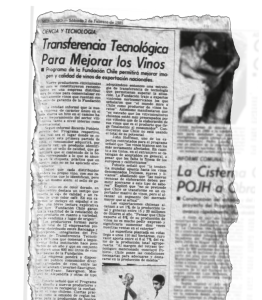
In 1985, Fundación Chile promoted a technology transfer program to improve wine quality, at a time when the wine industry had not yet achieved international recognition.
The project sought to improve the quality, consistency, and adaptation of wines to the demands of foreign markets, working with medium-sized producers in the central zone. A guarantee seal was created, certifying variety, harvest year, and origin, involving producers from Rancagua to Concepción.
This effort was key to repositioning Chilean wine abroad and gave way to new explorations, such as the demonstration company Agrícola y Vitivinícola Itata, created in 1990.
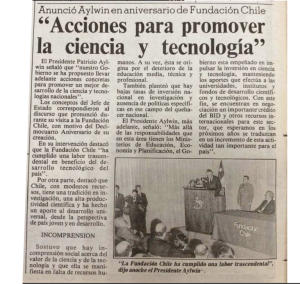
In 1990, as Fundación Chile marked its 14th anniversary, President Patricio Aylwin publicly highlighted its role in technology transfer and export growth. By then, the Foundation had refined its specialization and strengthened its international presence.
The agribusiness area held an advanced position, developing innovative companies, certifying export products, and generating investment projects. The quality control program for fresh fruits and vegetables became established as a national benchmark, turning Fundación Chile’s certification into a synonym of guarantee. In parallel, the forestry department played an active role in technology dissemination and the creation of new companies.
Fundación Chile was thus consolidating itself as a long-term institution, capable of transcending governments and political cycles.
Fundación Chile’s agribusiness area held an advanced position, developing innovative companies, certifying export products, and generating investment projects.
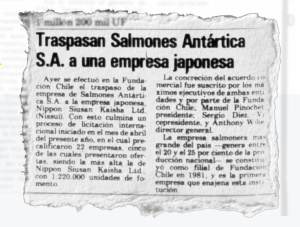
In 1988, Fundación Chile sold Salmones Antártica to Japanese investors. More than a financial transaction, it was confirmation that the model worked: create, scale, and transfer.
The company had demonstrated the technical and commercial feasibility of large-scale salmon farming, developing fish farms, grow-out centers, specialized feed, and unprecedented export processes, such as the first air shipment of fresh salmon to the United States.
The country-level impact was profound: salmon farming became one of Chile’s most relevant industries, reaching US$3.5 billion in exports in its first three decades and generating thousands of jobs.
In 2001, Educarchile was launched, the country’s first educational portal, developed by Fundación Chile in partnership with the Ministry of Education. The initiative was created to leverage information and communication technologies for educational purposes, offering resources aligned with the national curriculum. Educarchile became a national and Latin American benchmark. Fundación Chile collaborated with other countries, such as Colombia, and in 2004 promoted the Latin American Network of Educational Portals (RELPE).
Its milestones include the Esencial website after the 27F earthquake, the first free online university entrance exam preparation platform — awarded by WISE in 2012 — and its key role during the pandemic. Today, the portal incorporates artificial intelligence content and continues adapting to the challenges of the education system. In 2026, it will celebrate its 25th anniversary.
Educarchile, the country’s first educational portal, was created in 2001 to leverage information and communication technologies for educational purposes, offering resources aligned with the national curriculum.

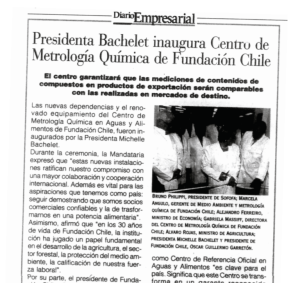
In 2003, the merger between Fundación Chile and the Technological Institute of Chile (INTEC) was approved. This union diversified R&D activities, integrating capacities in the environment, information technologies, and chemical metrology.
With this, Fundación Chile consolidated itself as a relevant actor in biotechnology, analytical chemistry, environmental management, and the development of labor competencies.
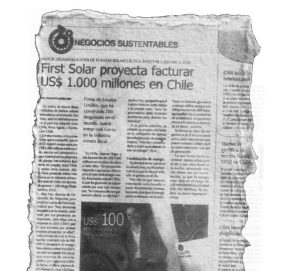
In 2013, First Solar acquired Solar Chile, an initiative promoted by Fundación Chile together with entrepreneurs and investors, aimed at transforming the Atacama Desert into a competitive and sustainable source of energy.
The creation and subsequent sale of Solar Chile positioned Fundación Chile at the forefront of the energy transition. In 2015, Chile ranked No. 10 worldwide in new investments in renewable energy.
The creation and subsequent sale of Solar Chile positioned Fundación Chile at the forefront of the energy transition.
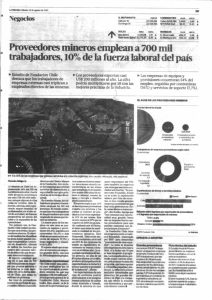
“Mining suppliers employ 700,000 workers, 10% of the country’s labor force,” read La Tercera’s headline on August 18, 2012, reporting on the Fundación Chile study that revealed that workers from external companies nearly tripled the direct employees of mining companies. At the time, the mining industry projected investments of around US$100 billion by 2020, along with a growing need for professionals, driven by the high level of activity, copper price outlook, and the expansion of operations.
In response to that scenario, Fundación Chile conducted, for the first time, a characterization study of mining suppliers, with the aim of identifying their comparative advantages, development potential, and the gaps that needed to be closed in order to reach standards that would allow them to become more sophisticated and internationalize.
This work was supported by Fundación Chile’s previous learnings in the industry, particularly through the Labor Competencies Program, which was a key precedent for the later Workforce Study of Chilean Large-Scale Mining. The diagnosis derived from these initiatives led to the creation of the Mining Skills Council (CCM), as a sectoral coordination space to structurally address human capital challenges in mining.
Based on this trajectory — which combined evidence, sectoral dialogue, and collaborative action — the foundations were laid for two strategic initiatives that would mark a new stage in Fundación Chile’s relationship with mining: on the one hand, the World-Class Suppliers Program, which gave rise to the open innovation model in mining that would later evolve into Expande, coordinating the technological demand of large companies with solutions developed by suppliers and startups; and, on the other, the CCM–Eleva Alliance, aimed at projecting a long-term agenda in human capital, productivity, and employability for the mining of the future.
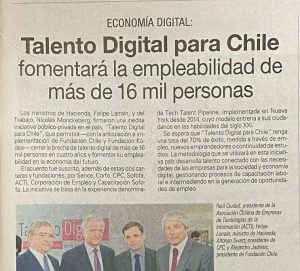
In 2019, Talento Digital para Chile was created, a public-private initiative promoted by Fundación Chile and Fundación Kodea to address the digital skills gap. The program became consolidated as a public policy for massive labor reskilling.
Six years after its creation, it has managed more than 30,000 scholarships, with a 77% job placement rate and an average income increase of 47%, also contributing to reducing gender gaps.
Talento Digital para Chile became consolidated as a public policy for massive labor reskilling.

In 2016, Fundación Chile launched Water Scenarios 2030 as a strategic response to the challenge of water security in a context marked by climate change, prolonged drought, and increasing water demand. The initiative emerged from a long-term vision that understood the water problem as a systemic challenge, requiring collaboration and comprehensive solutions beyond fragmented approaches.
The program convened actors from the public, private, academic, and civil society sectors to build a shared diagnosis and a common action agenda. One of its main milestones was the Water Snapshot, which made it possible to identify gaps, risks, and water projections at the national and basin levels, giving rise to the concept of Water Transition as a pathway toward a sustainable and resilient scenario.
Subsequently, Water Scenarios 2030 moved toward territorial action through roadmaps in strategic basins such as Maipo and Maule, promoting new water governance, greater efficiency in the use of the resource, ecosystem protection, and diversification of sources. Today, with a presence in territories such as Magallanes, Villarrica, and O’Higgins, the initiative has become consolidated as a key knowledge and advocacy platform to support public and private decision-making.
EH2030 was created in 2016 as a strategic response to the challenge of water security in a context marked by climate change, prolonged drought, and increasing water demand.
In the face of sustained growth in energy consumption and the increase in greenhouse gas emissions, energy efficiency became consolidated as a strategic challenge for Chile. In this context, in 2015 the Ministry of the Environment, the Ministry of Energy, and Fundación Chile implemented the global En.Lighten initiative, promoted by UN Environment, GEF, and U4E, with the aim of accelerating the efficient lighting market through citizen campaigns, innovation, and new business models.
From this collaboration emerged Cambia el Foco, an innovative lightbulb replacement model that reduced cost and information barriers, promoting the mass adoption of LED technology throughout the country. Through citizen campaigns, a mobile store, and replacement actions in educational institutions, public facilities, and emblematic spaces, the initiative achieved savings of up to 50% in the annual electricity consumption of beneficiary entities and increased LED lighting penetration by 40% between 2015 and 2018, laying the foundations for a broader campaign of energy efficiency and citizen education.
In 2015, the Ministry of the Environment, the Ministry of Energy, and Fundación Chile implemented the global En.Lighten initiative, promoted by UN Environment, GEF, and U4E, with the aim of accelerating the efficient lighting market through citizen campaigns, innovation, and new business models.
Fundación Chile promoted the launch of the labels we still see today on household appliances, which allow consumers to know which product is more energy efficient.
The label began to be used in Chile in 2007, starting with lightbulbs and refrigerators, given their high household consumption. In January 2008, it was officially presented with authorities from the Country Energy Efficiency Program, SEC, and Sernac.
In 2019, Fundación Chile promoted a key milestone by leading the transition toward a circular economy for plastics in the country, convening actors from across the entire value chain for the first time to align objectives, accelerate solutions, and develop capacities oriented toward a more sustainable model. This coordination marked the beginning of collaborative work to address the challenge of plastic waste in a systemic way.
The initiative, developed together with the Ministry of the Environment and driven by the Ellen MacArthur Foundation and WRAP, became consolidated as a platform that integrates the public sector, companies, academia, and civil society. Through this collective work, technical and regulatory barriers were addressed, design standards for recyclability were promoted, innovation was driven, and data quality was strengthened, resulting in the reduction of more than 75,000 tons of virgin plastic.
The Chilean Plastics Pact also incorporated a strong social and territorial approach, strengthening local collection networks together with grassroots recyclers and improving capacities and enabling conditions at the local level. Today, the Pact is a national and regional benchmark, connected to a global network, and is moving toward a new stage with 2026–2030 goals, aimed at keeping plastics within the economy and out of the environment.
From its beginnings, Fundación Chile understood innovation as a process that goes beyond technological development, betting on ideas even when there were no certainties or favorable environment. In a context where entrepreneurship and venture capital were still incipient in the country, the Foundation began exploring investment and company creation models that laid the foundations for a new approach to productive development in Chile.
A key milestone in this path was the creation of Salmones Antártica in 1982, which positioned Fundación Chile as the first venture capital actor in Chile and Latin America. This experience inaugurated a trajectory of demonstration companies aimed at identifying opportunities, taking risks, and supporting ventures with high transformative potential, even when the institutional and financial framework was not yet prepared for it.
Over the years, this model evolved from investing with its own capital toward strategic partnerships and scaling platforms for entrepreneurship and innovation. This process was consolidated in 2011 with the creation of Emprende FCh, which structured a support network for entrepreneurs and strengthened coordination among investment, knowledge, and productive development, later giving rise to ChileGlobal Ventures.
Today, ChileGlobal Ventures promotes technological entrepreneurship, open innovation, and impact investment, connecting talent, capital, and capacities to address global challenges. With more than 200 startups supported, the platform projects Fundación Chile’s legacy toward sustainable development, climate change, and productive transformation, including initiatives such as startupLab.01, the country’s first deep tech innovation hub, developed together with Corfo.
Over the years, FCh’s model evolved from investing with its own capital toward strategic partnerships and scaling platforms for entrepreneurship and innovation.
The history of Fundación Chile is the story of an institution that anticipates, connects, and transforms, keeping intact its vocation for the country’s development. A trajectory that looks to the future with the same conviction with which it began.
Fundación Chile is beginning a new stage marked by innovation, sustainability, and public-private collaboration, with an ambitious agenda aimed at addressing the country’s main productive, climate, and social challenges toward 2030 and 2050.
The beginning of its 50th anniversary not only commemorates five decades of institutional history, but also marks a turning point in which the organization will focus on seeking to accelerate structural transformations in the country’s development.
“The future is in our nature” is the organization’s phrase for this anniversary, demonstrating the innovative character and future-oriented vision that the Foundation has had, has today, and will continue to have over the next 50 years.
This is consistent with what its founder, Raúl Sáez, expressed in 1976, when he described the organization’s primary objective, which today remains more relevant than ever: “The role this institution had in the past and has had in the present only reinforces its importance in addressing future challenges.”
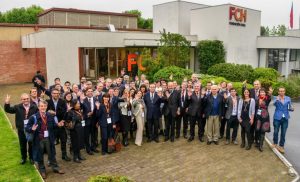
One of the most relevant announcements in the context of the anniversary is the consolidation of the Chile–Finland Technology Development and Transfer Platform, an initiative approved and financed by CORFO, implemented jointly by Fundación Chile and Finland’s VTT Technical Research Centre, and promoted together with the Ministry of Foreign Affairs. This strategic alliance seeks to design, adapt, and transfer innovative solutions to address challenges in key sectors such as sustainable mining, forest bioeconomy, the wood-based industry, and smart regional development.
For 2026, Fundación Chile has defined work with medium-scale mining as its first focus. The objective is to characterize and diagnose its main gaps, pilot innovations based on Finnish models, and subsequently scale these solutions to large-scale mining. The second focus is the promotion of the forest bioeconomy, encouraging the industrialization of timber construction and the development of biomaterials from cellulose and lignin, strengthening value chains with national companies and international partnerships.
In this context, on January 7, Fundación Chile signed a strategic agreement with SOFOFA, establishing a collaboration framework to promote technological innovation, industrial decarbonization, circular economy, bioeconomy, and the strengthening of environmental Monitoring, Reporting, and Verification.
The agreement will make it possible to advance in the development of technical capacities, environmental inspection laboratories, the updating of methodologies in line with international standards, and the design of the National Center of Excellence in Atmospheric Emissions.
In addition, as another important milestone of the platform, on April 28 a collaboration agreement was signed between Fundación Chile and the city of Tampere, seeking to deepen joint work in the development of innovation ecosystems, the growth of startups and SMEs, human capital development, and sustainable territorial development.
Fundación Chile will reinforce its commitment to science- and technology-based entrepreneurship as a driver of productivity, economic growth, and quality job creation. These types of ventures address strategic challenges in mining, energy, climate change, food, and agribusiness, and have high potential to generate economic and social value.
Startuplab.01, an initiative promoted by Corfo and Fundación Chile and the country’s first deep tech hub, will be the enabling platform for this growth. The goal is for it to have supported 200 science- and technology-based companies by 2030, contributing to the country’s competitiveness, the creation of specialized employment, and the development of innovative solutions with global scaling potential.
The premise is clear: decisive and collaborative action to accelerate Chile’s development while innovating in a form of development that does not generate emissions and, at the same time, restores nature.
Fundación Chile is already working on this through the “ConvergEN+: Energy and Nature Positive” initiative, supporting Chile in this challenge, which only 12 countries in the world have taken on.
Its major objectives are to reinforce the coherence, alignment, and complementarity of the various instruments and tools related to climate change; incorporate nature dimensions into climate change financing; and build capacities and raise awareness about alternatives for decarbonizing energy demand.
With this initiative, Fundación Chile will contribute to a reduction of 550,000 tons of CO₂ equivalent, representing approximately 9.2% of an annual reduction target of 6 MtCO₂e, constituting a relevant contribution to Chile’s decarbonization pathway toward 2050.
The organization’s technical, coordinating, and positioning capacity is once again reflected in this project, as it is an initiative of the Ministries of Energy, Environment, and Finance, financed by the Global Environment Facility (GEF), implemented by the United Nations Environment Programme (UNEP), and executed by Fundación Chile.
The organization is also leading an unprecedented collaborative effort with the construction industry, aimed at promoting concrete actions to integrate circular economy principles, reduce emissions, and decrease other environmental impacts. The initiative “Entorno + Circular: Toward Circular and Decarbonized Construction in Chile” will enable an additional estimated reduction of 350,000 tons of CO₂ equivalent, supporting the fulfillment of Chile’s Nationally Determined Contribution, updated in 2025, and promoting structural change in one of the sectors with the greatest environmental footprint.
This initiative demonstrates, as does “ConvergEN+: Energy and Nature Positive,” the full impact of the organization, as this project is led by the Ministries of Energy, Environment, and Finance, financed by the Global Environment Facility (GEF), implemented by the United Nations Environment Programme (UNEP), and executed by Fundación Chile.
Human capital development is a central pillar of Fundación Chile’s strategic outlook. In this context, the organization announced the scaling of Talento Digital para Chile, an initiative that has managed more than 30,000 scholarships nationwide, with concrete results in job placement, early employability, and income growth. The goal by 2030 is ambitious: to train one million people to participate in a digital and transforming economy.
Talento Digital is an initiative of the Ministry of Finance, Ministry of Labor, SENCE, InvestChile, IDB, Corfo, SOFOFA, ACTI, and CHILETEC, and is developed by Fundación Chile and Fundación Kodea.
As part of its strategic challenges and commitment to public-private coordination, Fundación Chile, together with the Ministry of Education, promoted Sumar Saberes, a public-private alliance that brings together actors from the public sector, civil society, academia, international organizations, and the private sector, with the aim of accelerating learning improvement in the country. Its initial focus has been on foundational learning, such as reading and mathematics, as well as school attendance and socio-emotional learning.
Sumar Saberes seeks to ensure that decisions within the education system are made based on evidence and not solely on intuition or institutional track record. The goal is to make visible what works in education, under what conditions, and with what potential for expansion, in order to better guide public and private resources and generate sustainable impact on the learning and educational pathways of children and adolescents.
This initiative is made up of Fundación Anglo American, Fundación BHP, Fundación Educacional Oportunidad, Fundación Luksic, Fundación MC, UNESCO, UNICEF, IDB, CAF, the UC Center for Public Policy, the Center for Advanced Research in Education of the University of Chile (CIAE), the Public Education Directorate, and the Education Quality Agency.
Fifty years after its creation, Fundación Chile reaffirms its commitment to sustainable development, innovation, and collaboration, projecting an agenda that seeks to transform the country’s challenges into opportunities for inclusive, resilient, and evidence-based growth, while making a concrete contribution to Chile’s development in the decades ahead.
Partnerships
and Networks
We believe in collaboration as a driver of change, which is why we build partnerships that enhance innovation and generate sustainable impact in Chile and around the world.
Committed to clarity and trust, here we share key information about our work in accordance with Chile Transparente standards.
Join an innovative team and create value through high-impact initiatives that strengthen Chile’s development and competitiveness.
Passionate about innovation, we work every day to build a sustainable future for the country.